
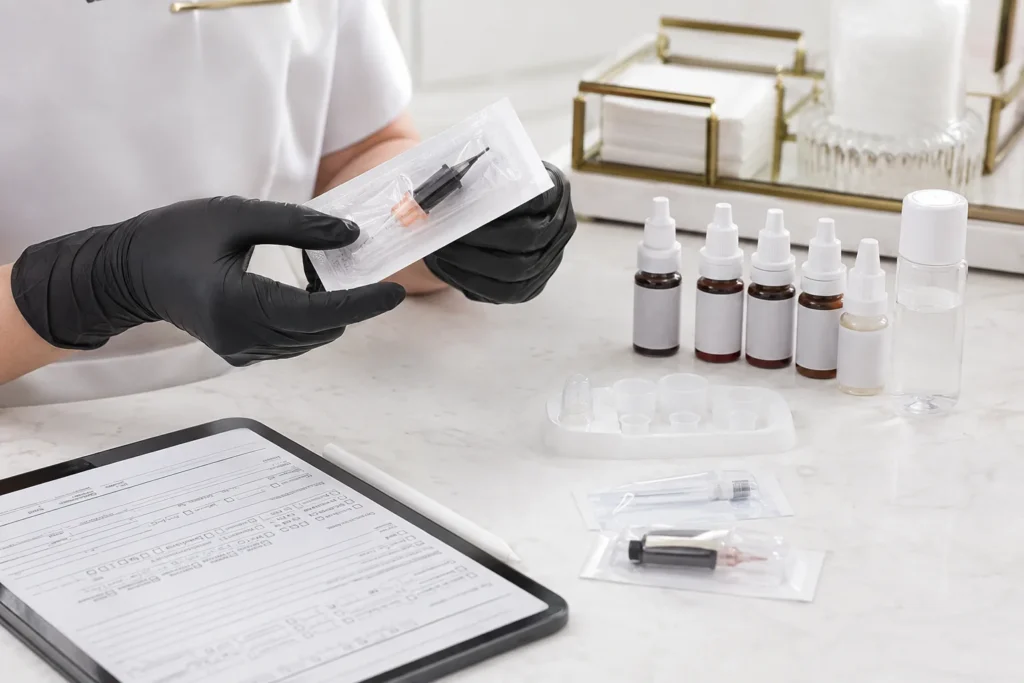
BAQA’s Permanent Makeup Standards are voluntary professional-practice guidance for cosmetic tattooing. They describe a controlled practice framework; they do not grant a licence, create healthcare status or replace mandatory requirements where a service is delivered.

Scope and terminology
This framework covers permanent makeup or cosmetic tattoo practice involving brows, eyeliner and lip colour, including relevant machine and manual methods. Scalp micropigmentation has a separate BAQA standard. Restorative or paramedical descriptions require particular care: the wording must not imply a regulated healthcare role, and practitioners must identify when additional competence, permission, insurance, referral or healthcare collaboration is needed.
Six controlled practice domains
1. Infection prevention
Risk-assessed hand hygiene, personal protective equipment, clean and contaminated zones, single-use sharps, validated processing where reusable items exist, environmental cleaning, waste controls and exposure procedures.
2. Consultation and consent
Procedure-specific information, private and proportionate intake, design approval, realistic limitations, separate photography choices, transparent price and a documented decision to proceed, postpone, decline or refer.
3. Procedure scope and planning
Work only within assessed competence, current insurance and local permission. Identify the exact method, treatment area, existing work, equipment, supervision needs and reasons not to proceed.
4. Products and traceability
Verify intended use and market requirements, packaging integrity, manufacturer information, storage, batch or lot and expiry records, contamination controls, supplier notices and recall response.
5. Records, aftercare and escalation
Maintain the agreed plan, procedure and product record, photographs where lawful and necessary, individual written aftercare, follow-up responsibilities, incident handling and clear routes for healthcare or authority escalation.
6. Ethics and professional development
Use truthful credentials and portfolios, protect dignity and privacy, manage conflicts and complaints fairly, review outcomes, correct misleading information and maintain learning relevant to the services actually offered.
Supporting BAQA guidance
PMU knowledge hub
Terminology and routes for clients, learners and practitioners.
Open the hubPMU training quality
Questions about curriculum, supervision, assessment and trainer evidence.
Review trainingPMU product traceability
A practical framework for product identity, client records and recall readiness.
Review traceabilityPermanent eyebrow guidance
Procedure-specific client questions for brow method, design approval and healed evidence.
Review browsPermanent eyeliner guidance
Eye-area consultation, scope, product and escalation questions.
Review eyelinerPermanent lip colour guidance
Lip colour objectives, health boundaries, visible healing and follow-up questions.
Review lipsPMU Level 4 outcomes
BAQA qualification outcomes and assessment expectations for permanent makeup.
Review qualificationMicroblading Level 4 outcomes
Procedure-specific learning and assessment expectations for microblading.
Review qualificationLicensing guide
Locate the official authority and current requirements applying where the work occurs.
Check local requirementsSelected source context
These sources support particular parts of the framework and do not create one global legal standard.
- US FDA tattoos and permanent makeup fact sheet — product-risk and US regulatory context.
- European Chemicals Agency tattoo inks and permanent make-up — EU/EEA chemical and labelling context.
- US CDC Standard Precautions — a healthcare infection-prevention reference used for principles, not a body-art licensing rule.
Evidence status: the detailed source-to-clause and named external-reviewer register is not yet published. Readers should not infer consultation, endorsement or regulatory adoption beyond the evidence explicitly shown.