How BAQA levels work: This is a BAQA professional standard level used to describe expected learning depth and competence. It is not automatically equivalent to a national qualifications-framework level, government award, occupational licence or permission to practise. Learners and providers must check recognition and licensing requirements in the country or region where the training will be used.

1. Introduction
1.1 Purpose of This Document
This document outlines the key competencies and standards for the Foundational Health & Safety Awareness (Level 2) course, recognized by the BodyArt Qualification Authority (BAQA). It serves as an entry-level introduction for individuals aspiring to pursue higher-level bodyart or related qualifications, ensuring essential knowledge of safety, hygiene, and legal obligations.
1.2 Who This Course Is For
- Aspiring bodyart professionals (e.g., tattooists, piercers, PMU technicians) or those transitioning from a different industry.
- Current studio assistants or junior staff who need formalized health and safety training.
- Anyone requiring a baseline understanding of hygiene standards, cross-contamination prevention, and workplace safety in the bodyart context.
2. Entry Requirements
- Minimum Age: Learners must generally be at least 16–18 years old (depending on local regulations).
- Basic Literacy: Ability to read and communicate in the language of instruction, ensuring comprehension of safety protocols.
- No Prior Experience Necessary: This course is designed as a foundational level, so no advanced background in bodyart is required.
3. Course Objectives
- Core Health & Safety Principles: Introduce learners to the fundamental concepts of sterilization, cross-contamination prevention, and personal protective equipment (PPE) usage.
- Regulatory Awareness: Familiarize learners with local or regional regulations and best practices related to bodyart hygiene and client protection.
- Risk Management: Develop an understanding of potential workplace hazards, effective accident prevention, and incident response.
- Foundation for Progression: Establish the baseline knowledge required for higher-level courses, such as Level 4 bodyart qualifications or studio management roles.
4. Learning Outcomes & Competencies
By the end of the Foundational Health & Safety Awareness (Level 2) course, learners will be able to:
- Identify Basic Hazards & Risks
- Recognize common hazards in a bodyart environment (bloodborne pathogens, sharps, chemical exposure, etc.).
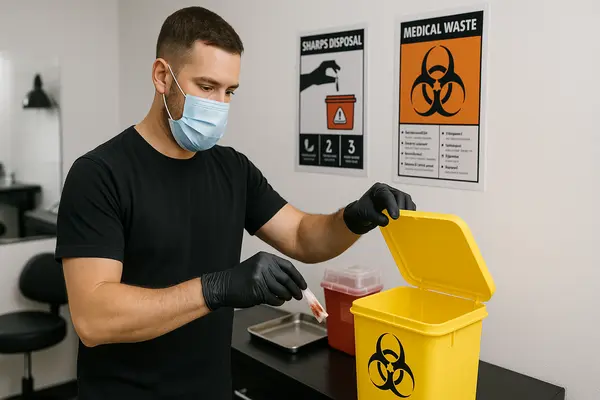
- Understand correct disposal procedures for contaminated or hazardous materials.
- Apply Fundamental Hygiene Protocols
- Demonstrate effective handwashing and sanitizing techniques, including the correct use of gloves and PPE.
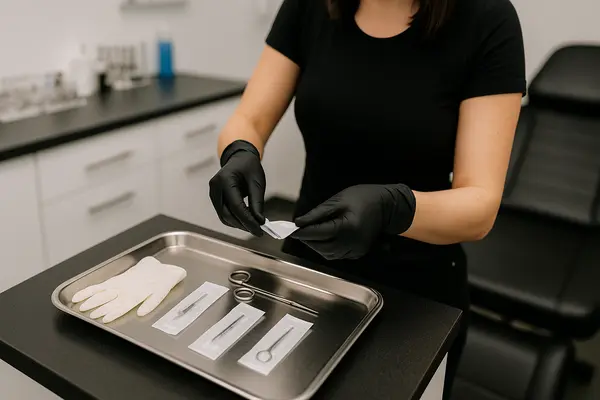
- Understand sterilization basics (e.g., cleaning equipment, single-use vs. reusable tools, avoiding cross-contamination).
- Comply with Workplace Safety Regulations
- Adhere to relevant local or national guidelines regarding health & safety, waste management, and employee rights.
- Maintain basic record-keeping for inspections or audits (e.g., sterilization logs, incident reports).
- Perform Basic Risk Assessments
- Assess daily studio or workspace set-ups to identify hazards (spillages, equipment malfunctions).
- Suggest appropriate controls or corrective actions to reduce risks.
- Respond to Incidents & Emergencies
- Outline immediate steps for minor injuries, needle-stick incidents, or chemical spills.
- Know basic first-aid principles and the escalation process when professional medical help is required.
- Maintain Personal Safety & Professional Conduct
- Dress and behave in a manner that upholds hygiene and fosters client confidence.
- Understand the importance of clear communication with colleagues, supervisors, and clients regarding safety matters.
5. Course Structure & Modules
A typical Foundational Health & Safety Awareness (Level 2) course might combine short lectures, demonstrations, group discussions, and practical exercises. Suggested modules include:
- Module 1: Introduction to Workplace Safety
- Overview of hazards in bodyart settings
- Basics of hazard identification and risk assessment
- Module 2: Hygiene & Infection Control
- Hand hygiene, personal protective equipment (PPE) best practices
- Introduction to sterilization methods (autoclaves, ultrasonic cleaners, single-use items)
- Module 3: Cross-Contamination Prevention
- Defining contamination pathways (airborne, contact, bloodborne pathogens)
- Correct studio layout and workflow to separate clean and used items
- Module 4: Workplace Regulations & Responsibilities
- Local legal frameworks for waste disposal, chemical handling, and staff training
- Employee rights and responsibilities (reporting hazards, safety committees)
- Module 5: Emergency Procedures & First Aid Basics
- Minor incident handling (e.g., needle stick, cuts, chemical splashes)
- Evacuation routes, fire safety, and basic first-aid steps
- Module 6: Risk Assessments & Practical Exercises
- Conducting a simulated workspace walkthrough to identify potential hazards
- Writing a brief risk assessment and proposing solutions
6. Assessment & Evaluation
6.1 Assessment Methods
- Multiple-Choice / Short-Answer Tests
- Evaluates theoretical understanding of safety regulations, cleaning protocols, and hazard recognition.
- Scenario-Based Questions
- Learners explain their response to incidents such as spills, needle-stick injuries, or suspected infection.
- Practical Demonstrations
- Observing correct handwashing, glove removal, or minor incident responses to assess skill application.
6.2 Grading & Feedback
- Pass/Fail or equivalent (e.g., Pass / Merit / Distinction), depending on your organization’s preference.
- Constructive feedback highlighting strengths and areas for improvement, especially relevant for those progressing to advanced qualifications.
7. Certification & Progression
Upon successful completion of this Level 2 course:
- Foundational Health & Safety Awareness (Level 2) certificate is awarded, recognized by BAQA.
- Learners are better positioned to advance to higher-level bodyart qualifications (e.g., Level 4 Tattooing, Piercing, PMU, Studio Management, etc.).
- If applicable, learners may be listed in a training database or registry noting their foundational safety competency.
8. Continuing Development
While Level 2 foundational training addresses essential health and safety concepts, further specialized training is encouraged:
- Level 4 Bodyart Courses for those pursuing full artist accreditation or studio management roles.
- Annual or Periodic Refresher Sessions to stay current with evolving local regulations or improved sterilization technologies.
- Advanced First-Aid or Bloodborne Pathogens (BBP) Certification for in-depth infection control skills.
9. Quality Assurance & Updates
BAQA and partner training institutions commit to:
- Regular Curriculum Reviews ensuring the course remains aligned with updated regulations, emerging best practices, and new research.
- Instructor Development so teaching staff maintain currency with health and safety knowledge, laws, and real-world application.
- Learner Feedback for continuous improvement in course delivery, content clarity, and resource provisions.
10. References & Supporting Documents
- BAQA Code of Conduct
- Local / National Health & Safety Regulations
- Applicable national or regional occupational health and safety requirements
- Industry Articles on Infection Control, Workplace Ergonomics, and Basic First Aid
- Manufacturer Guidelines for Sanitizers, PPE, and Waste Disposal Supplies
Conclusion
A Foundational Health & Safety Awareness (Level 2) course lays the groundwork for a safe and professional environment in the bodyart industry. By mastering core hygiene principles, local regulatory obligations, and incident response strategies, learners establish a reliable platform to advance into specialized roles and qualifications—reinforcing a culture of integrity, protection, and excellence in all bodyart settings.
“Health and safety underpin every successful bodyart practice—ensuring clients and professionals alike benefit from a clean, compliant, and confidence‐inspiring space.”
— BAQA Health & Safety Committee